2025 – The year that was
12 December 2025 at 2:08 pm
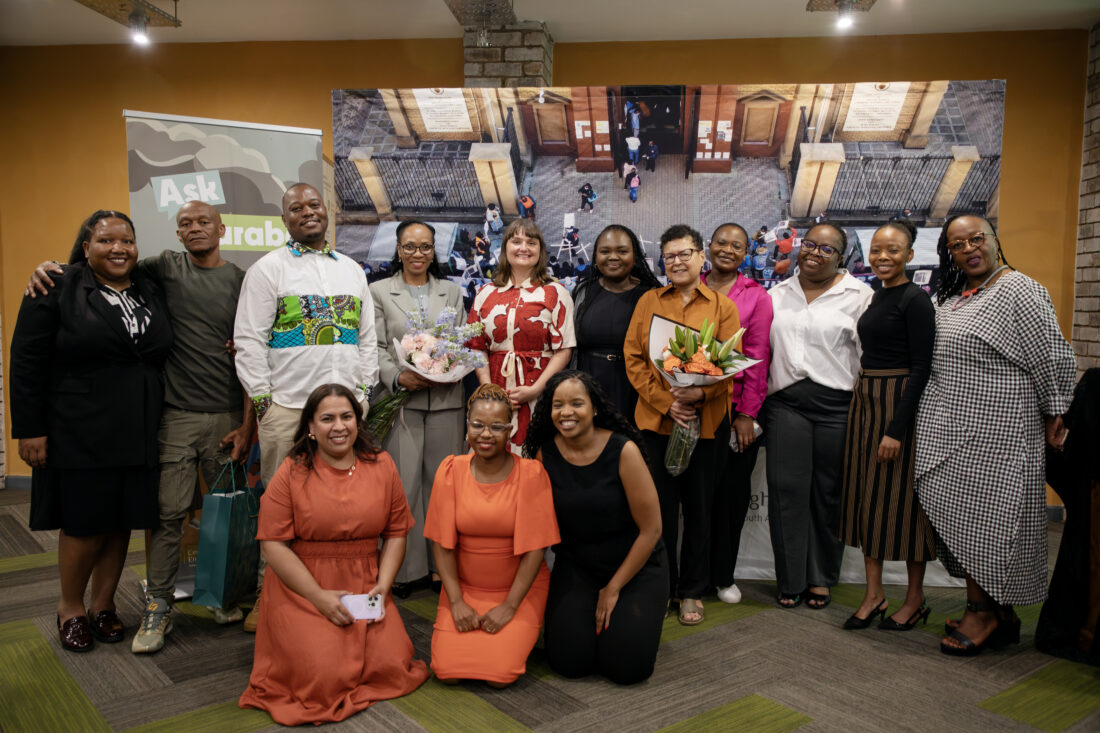
What a year it has been! 2025 has been a year of big strides, bold voices, and collective action marked by solidarity, learning, and meaningful victories across our spaces of work. We take this moment to celebrate the people who showed up, the progress we made together, and the impact we continue to make.
Here are a few highlights from this year.
Deadly Air Case Judgment
In April 2025, we secured a major and historic victory in the Supreme Court of Appeal on the Deadly Air Case. The court delivered a powerful ruling affirming that government must ensure that proper, enforceable rules are in place to implement the Highveld Air Quality Management Plan (Highveld Plan). This ruling makes it unmistakably clear that government must take to remedy the harm caused by dangerous air pollution in the Highveld and to finally make the right to an environment that is not harmful to human health.
Using the case of Deadly Air, it seems appropriate to send a reminder. The duty to respect, promote and fulfil the rights in the Bill of Rights is not some inconvenient truth public officials like ministers can wish away in their political tenure. It is the core function, if not their ultimate job in terms of the Constitution.
Public officials can’t fold their arms when circumstances warrant, they act on powers given to them by law, even when such powers are conferred in a permissive language. ‘Shame, askies’ and empty acknowledgment of a problem that causes harm to people, to the point of death, in some cases, is an inappropriate response to human suffering when you hold all the cards to use the law to put an end to such suffering.
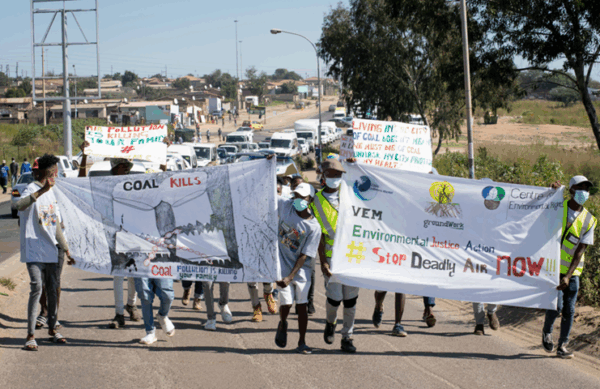
Defending lives from a sustained attack on air pollution laws
We challenged the exemptions granted to Eskom allowing it to bypass compliance with air pollution laws; the Minimum Emission Standards (MES) at eight power stations. Our case argues that these exemptions are unlawful and undermine South Africans’ constitutional right to a healthy environment. At a time when global leaders placed clean air firmly on the G20 agenda, this work reaffirmed our commitment to protecting public health and holding major polluters accountable. Following the groundbreaking Deadly Air judgment, we are anticipating this legal
challenge with hope that the courts will yet again protect the vulnerable and protect rights from toxic air pollution.
Making shareholders do right by people and the planet
In this year, we have continued our shareholder activism work to place climate concerns firmly on the agenda of corporations. At this year’s Sasol AGM, we raised questions about Sasol’s gas-to-power and methane-rich gas plans. We indicated that natural gas has environmental and economic risks associated with its exploitation. Importantly, public and private financiers must decide whether the continued support of gas projects is worth the risks attached, including reputational risk. We asked how the company will protect both shareholders and vulnerable households from financial risks, and how it will ensure that increased methane use does not undermine air quality, public health, or climate commitments. Alongside this, CER also engaged financiers throughout the year, encouraging stronger climate-aligned decision-making and more responsible approaches to gas financing.
Shareholder Activism Fact Sheet
Shareholder activism is an important tool that empowers ordinary people to hold companies accountable. This year we produced a Shareholder Activism sheet which breaks down how activists can participate in decision making spaces in companies that affect them by simply owning one share to gain the right to speak up at a company’s yearly meeting, ask tough questions. This work is important to ensure companies make sound decisions and reprioritise people and the planet when making profits.
Ask Karabo
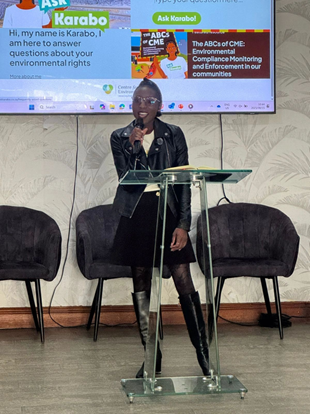
This year we launched Ask Karabo. This is an environmental education and advocacy tool aimed at capacitating and empowering communities, youth and children on their environmental rights.
The platform is designed to:
– Answer all your questions on environmental rights
– Guide communities on how to report pollution and environmental harms
– Provide practical tools and resources for real-world action.
In a country where environmental laws are strong on paper but weak in practice, Ask Karabo bridges the gap by
making the law accessible to everyone – from activists to everyday citizens
Rights and Remedies (R&R) Course
In 2024, at the Centre for Environmental Rights, we paused our flagship Rights and Remedies course to reflect through a monitoring and evaluation process in which all aspects of the course were reconsidered. This year we saw the fruits of this R&R reflection and consolidation process, with renewed direction, focus and energy.
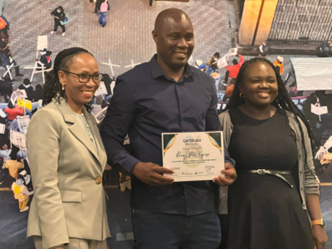
2025 marked an exciting comeback for R&R. At this year’s R&R graduation, we were honoured to have the President of the Supreme Court of Appeal, Justice Mahube Betty Molemela deliver a keynote address. The course was hosted in Gauteng for the first time, and we were joined by 15 passionate environmental community activists from the Northern Cape, Mpumalanga, Eastern Cape, North-West, Gauteng and Limpopo for 3 weeks of intensive legal and advocacy learning on a wide range of practical topics for activists.
As always, the activists bring rich experience and knowledge to R&R and the environment is designed to foster mutual sharing and learning that enriches the facilitators as much as the participants.
This was the 8th edition of R&R, and this year’s participants will now join over 115 other graduates in the R&R Alumni Network.
3rd Annual Anti Repression Symposium
The Centre of Environmental Rights partnered with the Centre for Applied Legal Studies, and other organisations to host the third Annual Anti Repression Symposium at the University of Witwatersrand. Participants examined the tools and tactics needed to resist systemic repression, misinformation, and economic constraints.
Public Interest Law Gathering
The Centre for Environmental Rights, together with other organisations, once again orchestrated the Public Interest Law Gathering (PILG), an annual forum that brings together lawyers, activists, researchers, and community organisers to reflect on the state of public interest lawyering in South Africa and the growing challenges facing communities. One of the most powerful takeaways from PILG 2025 was the emphasis that justice must live not only in courts and legal systems but in communities, movements, and everyday organising. Participants called for stronger civil society collaboration, activation of Chapter 9 institutions during crises, and community-led preparedness plans. The takeaway was clear: accountability must be driven from the ground up.
People’s Hearing – Human Rights Defenders
To mark the fifth anniversary of the assassination of Fikile Ntshangase on 22 October 2025, Life After Coal hosted the People’s Hearing for Human Rights Defenders at the Women’s Jail, Constitution Hill in Johannesburg. The Hearing created a powerful platform for community activists to share their lived experiences and highlight the escalating violence they face for resisting mining corporations and state interests that undermine environmental, social, and human rights.
We the 99% People’s Summit
As the country prepared to host the G20 summit in Nasrec from 22-23 November, civil society organisations called for government to priorities climate justice, invest in renewables, reduce debt distress and tax billionaires. CER presented at a G20 panel discussion looking at whether the G20 Summit can truly and sustainably impact the lives of those communities’ facing injustice and environmental rights violations.
Producing knowledge through research
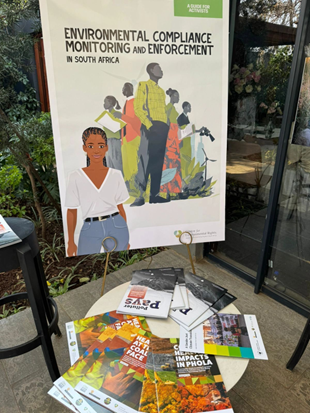
As experts in the field of Climate Change, we have continued to conduct critical research and produce evidence-based reports that shed light on various aspects related to understanding and mitigating climate change in the country and the world.
In 2025, CER launched the following reports:
•Research report on mine blasting
•Research report on financial provisioning and rehabilitation
In 2025, CER launched the following websites:
•Ask Karabo
•Report Environmental Violations Portal
•Rights & Remedies
•Mine Blasting
Looking forward to 2026
Together, we have made meaningful progress— we still have a great journey ahead of us — protecting our environment, empowering communities, and ensuring that the constitutional right to a healthy environment is upheld and strengthened.
We are grateful to all those who partnered with us throughout the year, and we look forward to an even bigger and bolder year in our pursuit of true environmental and climate justice.
The CER will be closed from December 12 and opening again on 12 January 2026.